AI agent for candidate prequalification: how it works, step by step
First contact, call or messages, assessment, report: what an AI phone prequalification agent does, step by step, and what stays in the recruiter’s hands.
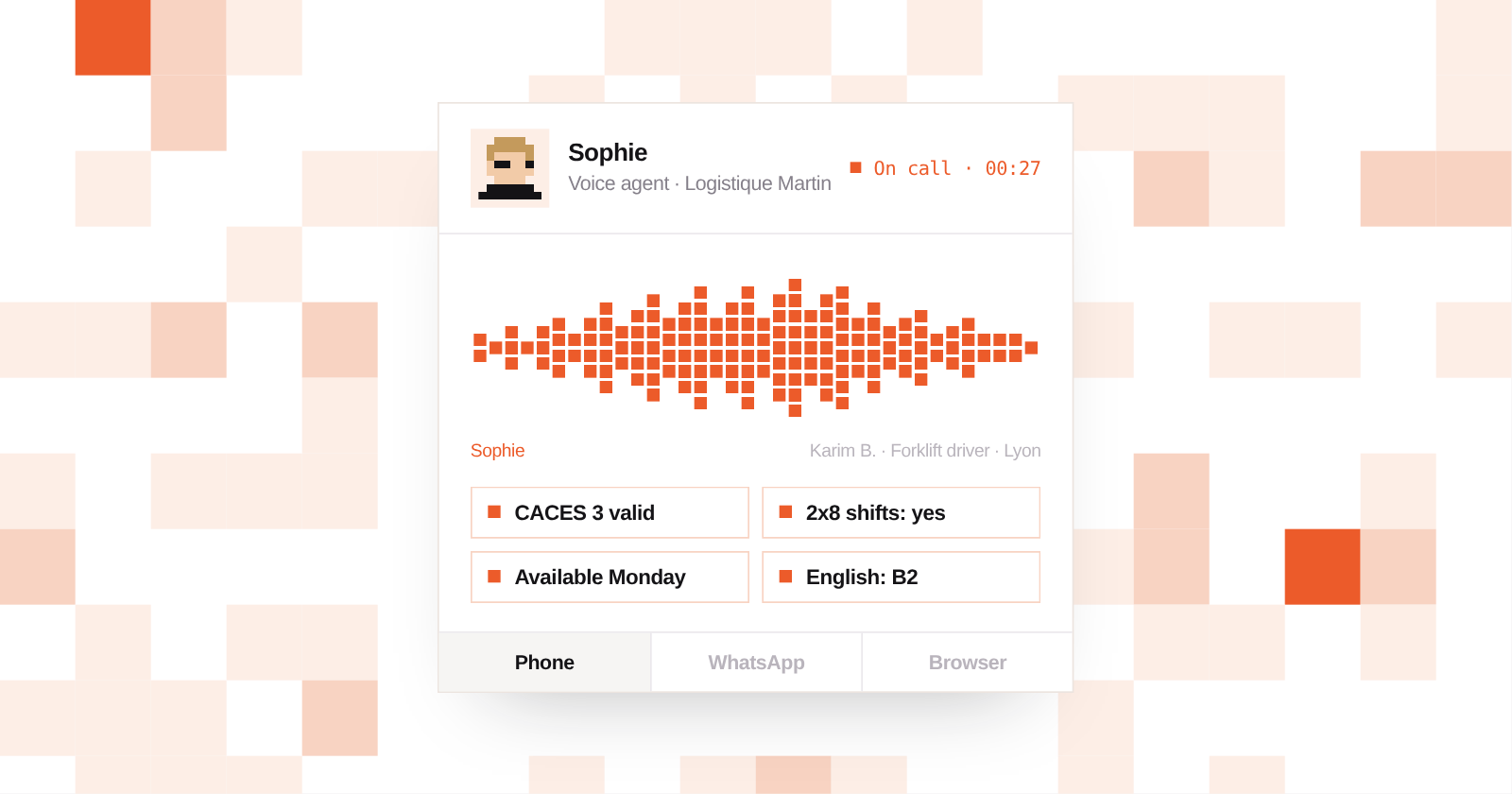
An AI agent for candidate prequalification holds the first conversation with every applicant on your behalf: it contacts them, asks your questions by phone, on WhatsApp or by message, assesses their answers against your criteria, then hands you a report. Automated phone prequalification, often called pre-screening, does not replace the interview with a recruiter: it settles everything that can be settled beforehand, so that your team spends its time with the right candidates.
This article explains what such an agent does, step by step, and what stays in the recruiter’s hands.
What is an AI prequalification agent?
It is an assistant that takes charge of one specific stage of recruitment: the first conversation. The one where you check the points that decide what happens next, before blocking out time in a recruiter’s diary. Does the candidate hold the licence or certification required? Are they happy with the working hours? When can they start? Do they speak the language the role needs?
Take an example. Logistique Martin, a French temp agency recruiting forklift drivers in Lyon, receives applications all week long. For each one, it needs to know whether the candidate’s CACES 3 (France’s forklift licence) is valid, whether a two-shift pattern (2x8) suits them and when they could start. The questions never change, but asking them one by one, over the phone, takes up a good part of every day. That is exactly what the agent does in the team’s place.
The agent does not come up with its own questions: it follows the plan you have defined for the role, with your criteria and your requirements. You also give it an identity: a name, a voice, a personality, a language and the context of your company. Candidates talk to someone who sounds like your employer brand.
How does automated prequalification work, step by step?
1. First contact
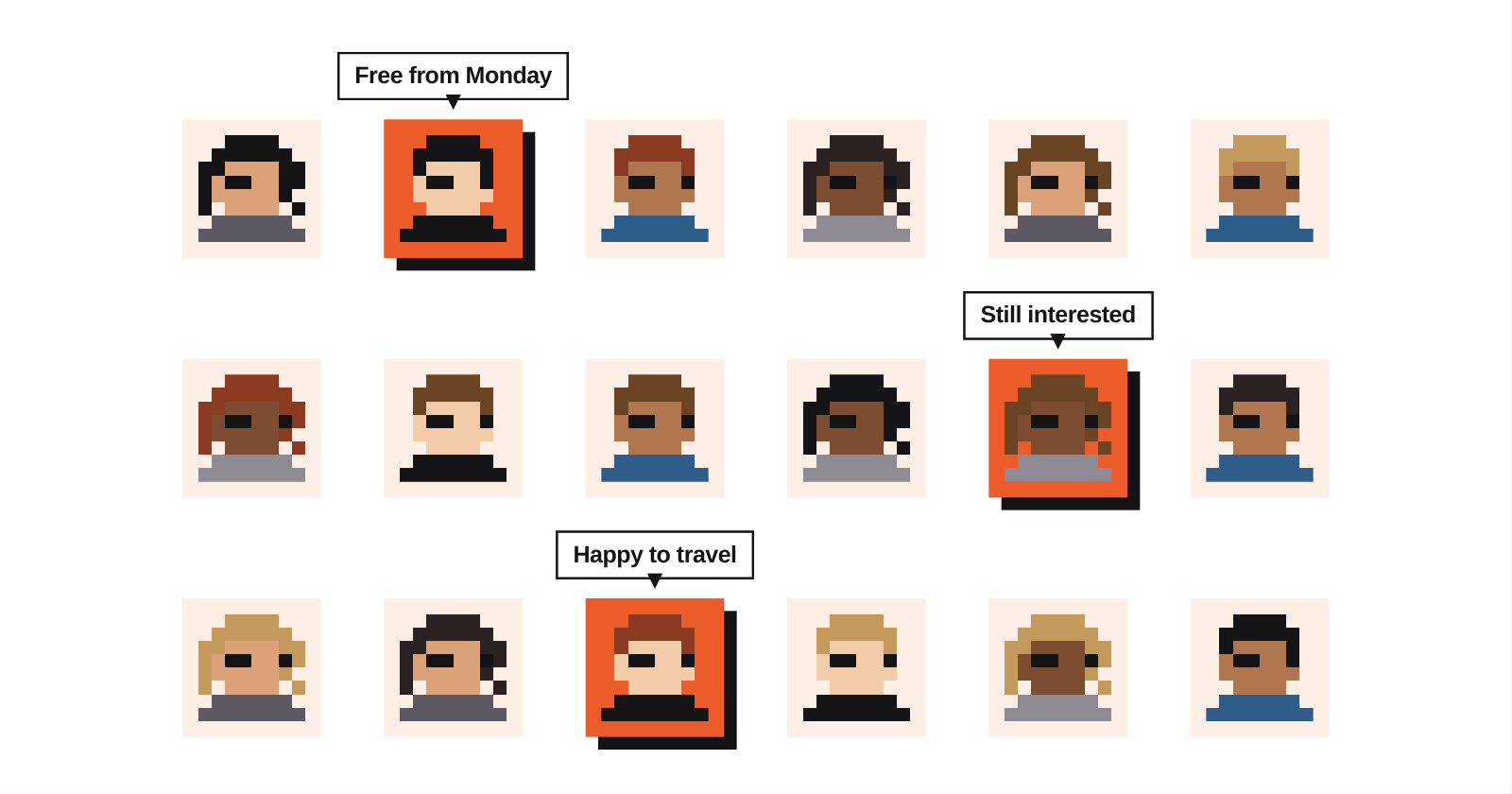
The agent first contacts the candidate by SMS, by email or on WhatsApp. It does not call out of the blue: it invites them to choose when the conversation takes place. The candidate can reply “Now” or pick a later slot, including in the evening or at the weekend. Many candidates already have a job and cannot pick up in the middle of the working day: that is often where the first calls get lost.
2. The conversation: call, WhatsApp or browser
The interview can take place in several ways, depending on what you have set up for the hiring project:
- by phone, at the time the candidate chose;
- by WhatsApp call;
- by WhatsApp message, in writing, with voice notes that the agent understands;
- in the browser, from a link received by SMS or email, with no app to install.
If the candidate does not pick up, they can restart the call from the link they received, or choose another time, up to three calls per 24 hours. And if the call is cut off before the end, the answers already given are kept: when the candidate restarts the call, the conversation picks up where it left off, without going over everything again.
The conversation can be held in six languages: French, English, German, Spanish, Italian and Portuguese.
3. Assessment, question by question
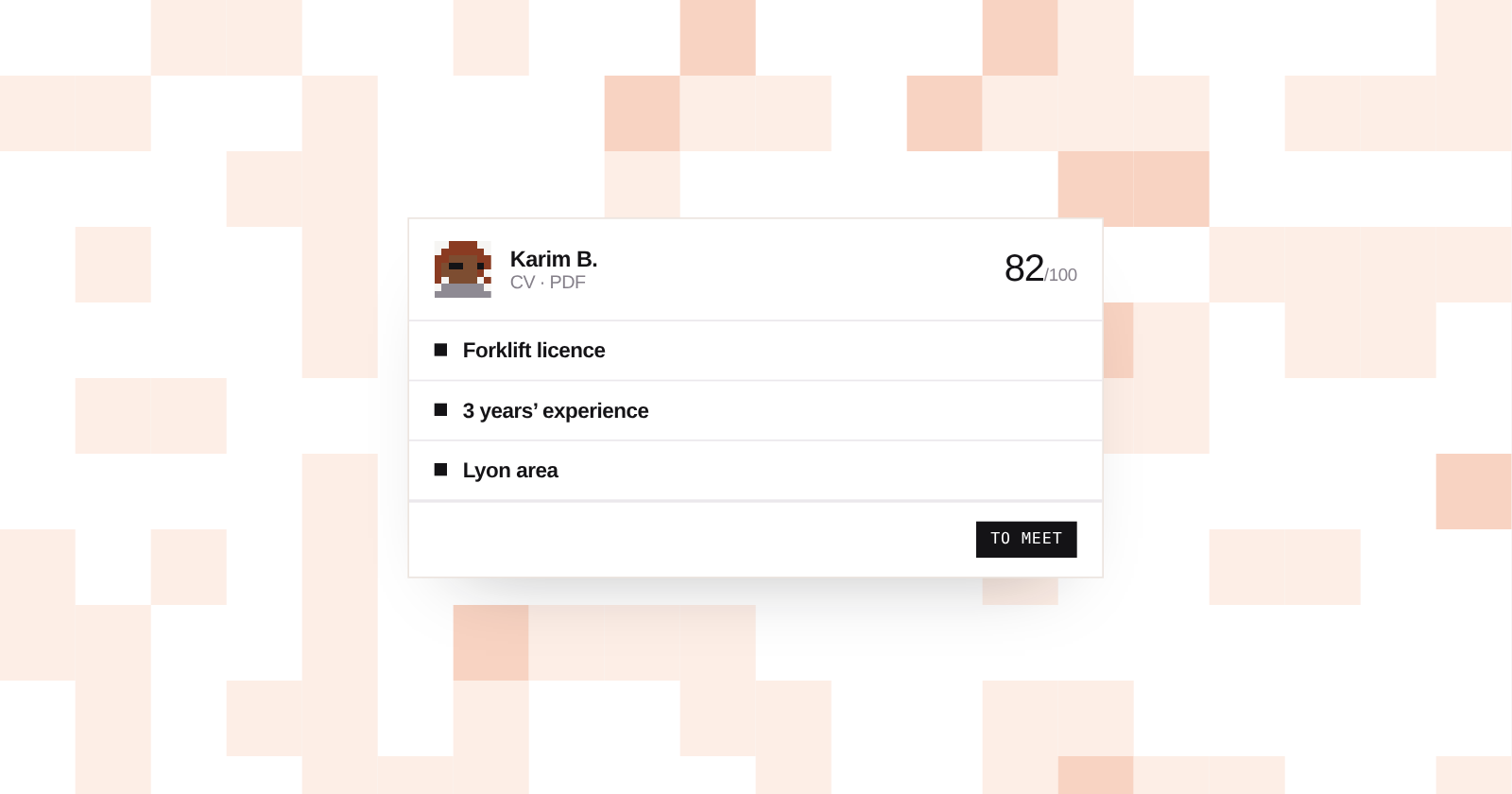
Each answer is assessed against the criteria you set for that question: its importance, the expected threshold, the score obtained and the justification, quoting the candidate’s own words. A question is never buried in an overall score: it is marked as answered, unanswered or to be reviewed.
If the role requires a language, the agent can run a test during the conversation. The level is assessed against the CEFR, the Common European Framework of Reference for Languages, across five dimensions: vocabulary, grammar, coherence, fluency and sociolinguistics.
4. The report
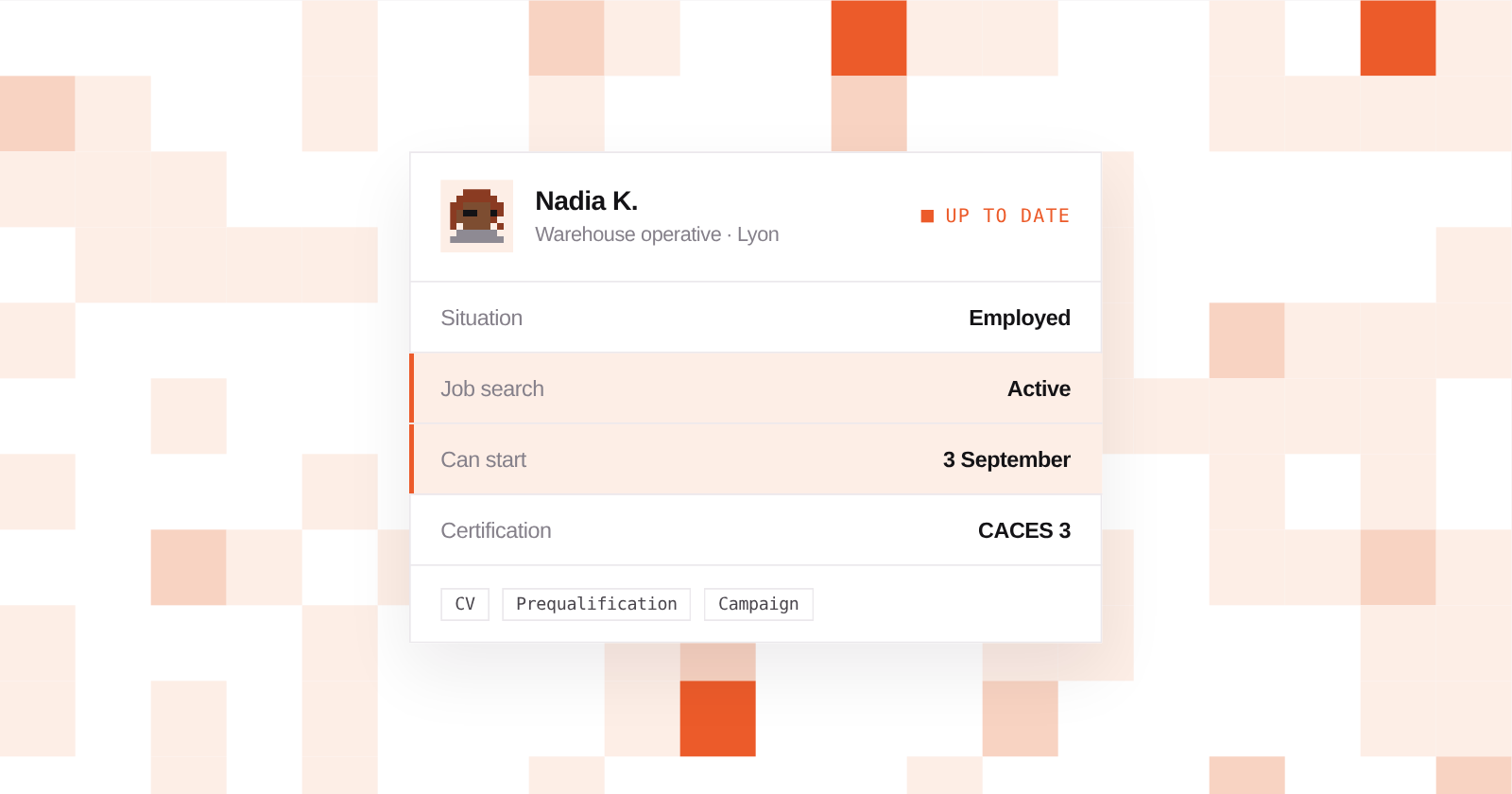
At the end, everything is brought together on the candidate’s profile: a summary, the scoring, the answers, the transcript, the audio recording and a PDF report. For our forklift driver, the summary might read like this:
Five years of forklift driving, valid CACES 3, available Monday, comfortable with the two-shift pattern.
If your team works in an ATS, the reports are sent there too: Beetween is already connected.
Phone, WhatsApp or messages: which channel should you choose?
There is no single right channel. The choice depends on the candidates you are targeting and on what you want to check.
| Channel | When to favour it |
|---|---|
| Phone call | The role calls for confidence speaking, or you want to test a spoken language. |
| WhatsApp call | Your candidates already live on WhatsApp and prefer a call to writing. |
| WhatsApp messages | Candidates have little time for a call, or respond better at their own pace. |
| Browser call | The candidate would rather talk from a simple link, with no app to install. |
For frontline jobs, WhatsApp is often the simplest option: it is the app candidates already open several times a day. For a role dealing with international customers, a call with a language test will tell you more.
Which questions should you hand to the agent, and which should you keep?
The agent is at ease with factual, verifiable questions: a certification, a licence, the hours a candidate will accept, how far they can travel for work, a start date, salary expectations, a language level. These are the questions that rule a candidate in or out quickly, and that a recruiter asks dozens of times a week.
Keep for your recruiters whatever calls for judgement: deeper motivation, fit with a team, negotiation, the final decision.
A few tips for writing a good prequalification plan:
- phrase each question as you would ask it on the phone, without internal jargon;
- keep must-have status for the real conditions of the role (a missing CACES, for example), not for preferences;
- set a realistic threshold, then read the first reports to fine-tune it;
- keep the number of questions down: a short conversation is more likely to be completed.
What stays with the recruiter?
The part that matters most: the decision. The agent assists and recommends; it does not hire anyone. The Pending, Review and Error statuses keep the recruiter in control: an incomplete or ambiguous file goes back to a human instead of being decided automatically.
Every assessment keeps the criterion, the answer, the status, the score and the evidence behind it. Your team can review, check and take over everything, as the EU AI Act requires. Call quality is documented too: duration, completion, audio and transcript.
As for data, everything is hosted in the European Union and processed in line with the GDPR.
What happens after prequalification?
Prequalification is only one stage of the journey. Before it, automated CV screening can set aside the applications that do not meet the basic conditions (we go through the method in our article on AI CV screening). After it, other agents can take over:
- collecting missing information and documents, such as a driving licence or an ID;
- sending an interview booking link to the candidates you select, connected to the recruiter’s calendar.
You only switch on the stages you need. For Logistique Martin, it might look like this: the CVs come in, the agent prequalifies the forklift drivers that same evening, and the next morning the recruiters only call back the candidates marked Approved, with their complete file in front of them.
Where should you start?
The simplest approach is to start from a real hiring project, with its real questions. Write five or six questions, mark the must-haves, choose the channel, then read the first reports before widening the scope. The agent is described in detail on the prequalification page, and pricing on the Pricing page: a subscription per seat starting at €49 a month, with credits included.
If you would like to see what prequalification does on one of your own roles, the free trial gives you 500 credits for 7 days, no credit card required.