Talent pool: re-engage past candidates with AI campaigns
Update and Re-engagement campaigns: how an AI agent reaches back out to your talent pool on WhatsApp, by SMS or by email, updates candidate profiles and offers them your jobs.
A talent pool is only worth something if it is up to date. Yet most CV databases are fast asleep: hundreds of profiles frozen at the date of their last CV, with nobody quite sure any more whether those people are in work, available or even still living in the area. Skillee Campaigns are there to wake that talent pool up: an AI agent gets back in touch with your past candidates on WhatsApp, by SMS or by email, either to find out where they stand (an Update campaign) or to offer them a specific job (a Re-engagement campaign).
This article explains the difference between the two, how each campaign runs, who gets contacted, and how the budget stays under control.
Why does a talent pool end up going dormant?
Every new role brings the same question: who, among the people you have already met, might be a good fit? The answer is often sitting in your CV database. Finding the right profiles is one thing, and that is the job of a search such as Talent Rediscovery, which reranks your profiles from a plain-language description.
Knowing whether those people are still available is another matter. A CV tells you who someone was on the day they sent it. A year later, they may have found a job, moved house or changed direction. To find out, you have to get back in touch, and that is precisely what a team has no time to do for hundreds of profiles. So you repost the job ad, start again from scratch, and the talent pool carries on ageing.
Update or Re-engagement: which campaign should you launch?
Both campaigns contact people in your CV database, but they are not after the same thing.
| Update | Re-engagement | |
|---|---|---|
| Goal | Know where each person stands | Fill one specific job |
| Who is contacted | The profiles you choose with the CV database search and filters | The profiles the AI picks for the job, adjustable by hand |
| Channels | WhatsApp or email | WhatsApp, or SMS and email |
| Expected result | An up-to-date profile | An application in your hiring project |
| Frequency | Once, or anywhere from weekly to every three months | Once, for the job |
The two work hand in hand. A Re-engagement campaign only goes to people whose profile shows they are actively looking or open to opportunities: the more up to date your profiles, the more people it finds to offer the job to. The Update campaign tells you who is looking; the Re-engagement campaign offers the job to those people.
How does an Update campaign bring your profiles up to date?
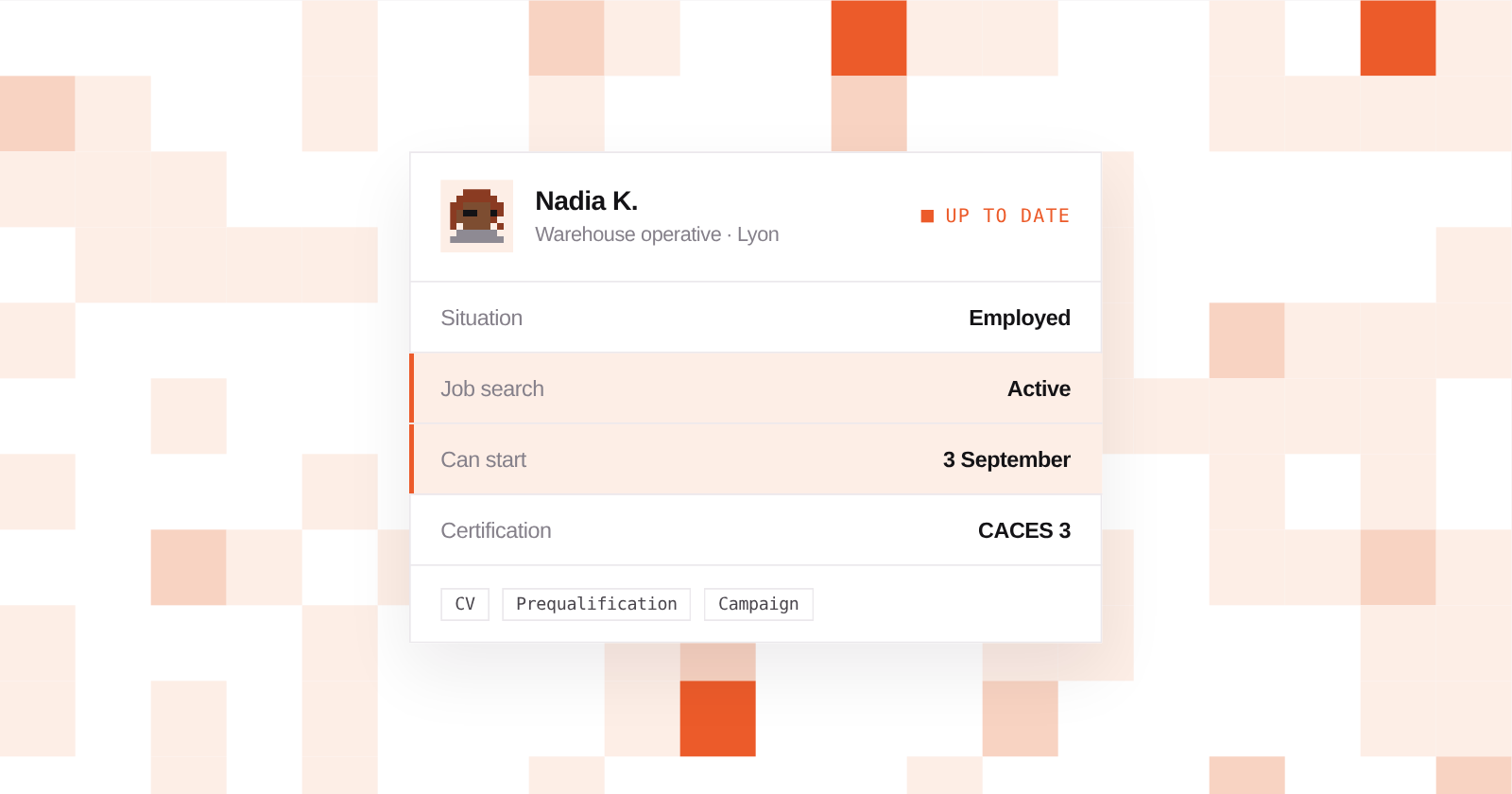
First, you choose the profiles to contact using the CV database search and filters: for example, forklift drivers and warehouse staff around Lyon. Then you list the information you want to collect. The Studio suggests several items (employment situation, current job, job search, availability date, mobility, salary expectations…), and you can add questions of your own.
The agent then runs the conversation on WhatsApp or by email. Emails go out from your own Gmail or Outlook mailbox, and the conversation carries on in the same thread. On WhatsApp, candidates can even reply with a voice note.
Two rules protect the quality of your profiles:
- the agent only keeps a piece of information if the candidate gave it themselves, in their own words;
- the conversation stays available in the campaign, so your team can see where each update came from.
The campaign can run once or repeat, anywhere from weekly to every three months, with 90 days between two updates by default. And so as not to approach the same people too often, by default it does not write to anyone your agents contacted less than 90 days ago; you can change that interval when you create the campaign.
Once the conversation is over, what the candidate told the agent can also enrich the rest of their profile: experience, skills, summary. We explain how this works in our article on the CV database that keeps itself up to date.
How can you re-engage past candidates for a specific job?
A candidate re-engagement campaign starts from a hiring project. To decide who to contact, the AI reads the job ad, draws its criteria from it and scores every profile in your CV database, using the same grid as Talent Rediscovery. The profiles it selects come pre-ticked. You can remove some, or add others with the search and filters: the final selection is yours.
The job is then sent through one of two channels:
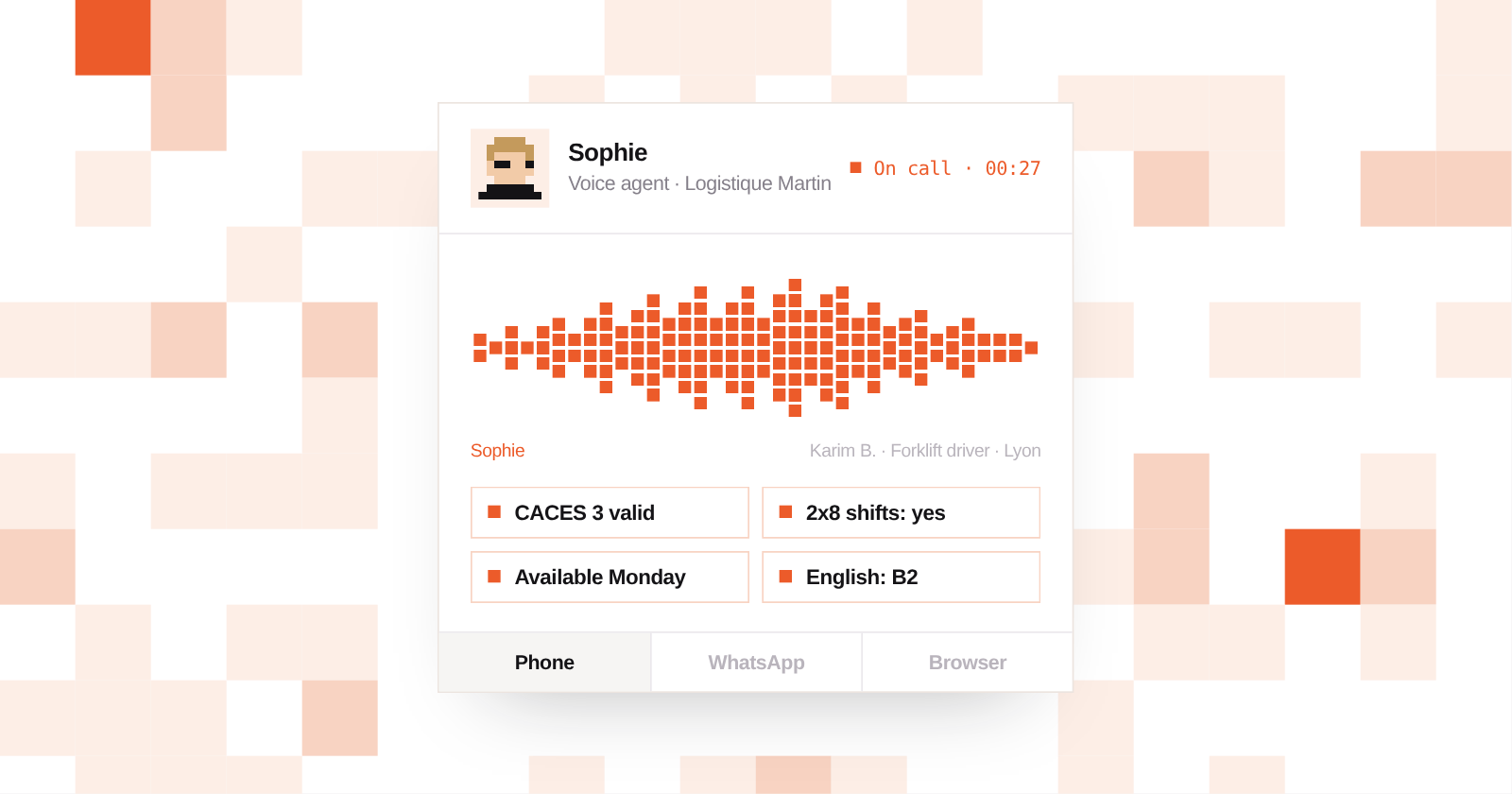
- on WhatsApp, the agent presents the role, answers the candidate’s questions about the job, and creates the application when the person clearly says they want to apply;
- by SMS and email, an email goes out from your Gmail or Outlook mailbox with the job and an “Apply for this role” button, then an SMS lets the candidate know it has arrived. The button opens a page presenting the job, and the application is only recorded once the candidate confirms.
Either way, the application joins your hiring project and follows the steps you planned for the job: CV screening (see our article on AI CV screening), then prequalification, for example, which we walk through in our article on the AI prequalification agent.
An example: a temp agency wakes up its forklift drivers
Let’s take a fictional example. Logistique Martin, a French temp agency based in Lyon that recruits forklift drivers, has built up hundreds of CVs from forklift drivers and warehouse staff over the years. It launches an Update campaign called “Forklift drivers and warehouse staff” on WhatsApp, repeated every three months.
Karim B., a forklift driver, had not heard from the agency for fourteen months. He replies:
I’m looking again, available from 1 March, up to 30 km from Lyon.
His profile moves to “Actively looking”, with a possible start date of 1 March; his mobility can still be read in the campaign conversation. Inès M., an order picker, replies that she has found a job and asks to be contacted again in three months: her profile records this, and no campaign will write to her before then.
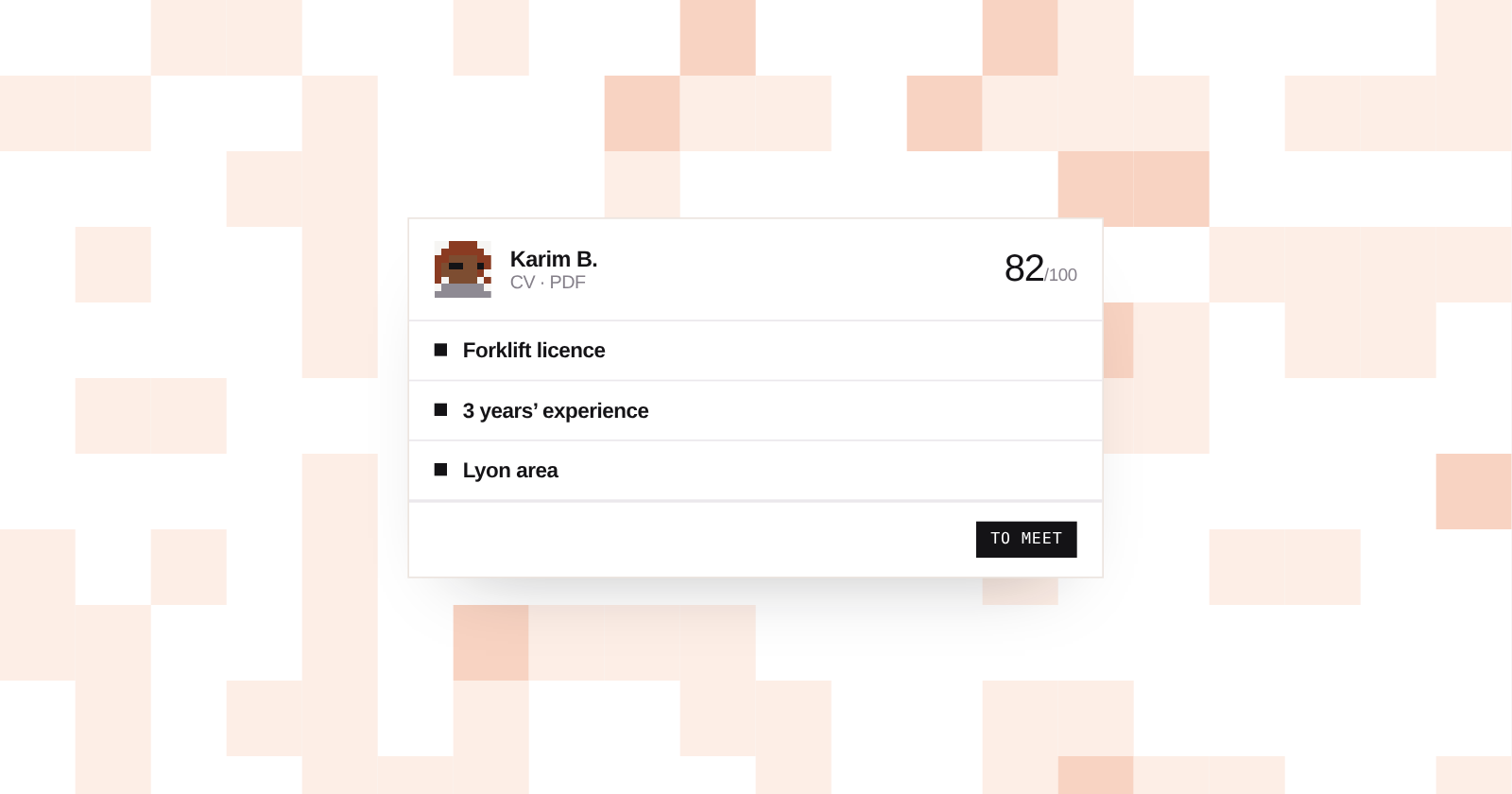
In February, one of the agency’s clients needs forklift drivers with CACES 3 (France’s forklift licence) in Vénissieux, just outside Lyon. The agency creates the hiring project and launches a Re-engagement campaign. Karim, now looking for work, is among the profiles selected. He receives the job on WhatsApp and asks about the working hours; the agent answers using the job ad, and Karim says he wants to apply. His application lands in the hiring project and moves on to prequalification. By the time the recruiter calls him, the report is already in front of them.
Who gets contacted, and who doesn’t?
The following are always left out:
- people who already have an application in one of your open hiring projects;
- people who have asked not to be contacted again, which your team cannot override;
- people who have asked for a pause, until the date they gave;
- people missing the contact detail the channel needs: a phone number for WhatsApp, an email address for email.
A Re-engagement campaign also leaves out people already linked to the job, people who have turned it down and people whose profile does not show that they are looking for work.
A request to pause or stop is only recorded if the candidate expressed it themselves. And if one of your hiring projects picks up the conversation with that person on WhatsApp, the campaign steps aside: the candidate only ever deals with one point of contact at a time. All data is hosted in the European Union.
How much does a campaign cost, and how do you stay in control?
You set a budget, and it is never exceeded: each contact reserves its maximum price before it goes out. That price is then paid in credits according to the step reached:
- the message being sent;
- the candidate’s reply, whatever it is, a “no” included;
- the result: an application, or an updated profile.
If there is no reply after three days, the conversation ends and anything reserved but not spent goes back into the budget. For a Re-engagement campaign, the AI matching is paid for when you run it, like a Talent Rediscovery search. The Studio shows your usage as the campaign progresses, and you can pause it at any time: no new messages go out, and conversations already under way run their course.
Full pricing is on the Pricing page: the subscription starts at €49 per month per seat, with credits included.
Where should you start?
Start with a role you hire for often. Launch an Update campaign on the matching profiles, read the first replies, then offer your next job to the people who are looking with a Re-engagement campaign. The whole process is described on the Campaigns page.
To try it on your own talent pool, the free trial gives you 500 credits for 7 days, no credit card required.