AI CV screening: automating shortlisting, criterion by criterion
How automated CV screening works: criteria, must-haves, a score that is calculated and explained. Why the score has to explain itself, and where the tool stops.
AI CV screening means handing the first read of every application to an agent: it reads each CV, checks whether it meets the job’s criteria and suggests a status. Done well, it lets you automate candidate shortlisting without losing control: every application is read against the same grid, and every verdict comes with its reason. Done badly, it produces an opaque score that nobody can explain.
Here is how automated CV screening works, criterion by criterion, why the score must be able to justify itself, and where its limits lie.
How does automated CV screening work?
It comes down to four steps.
- The CV is read and structured. CVs arrive in all shapes and sizes: PDFs, scanned documents, multi-column layouts. Optical character recognition (OCR) turns the document into a usable profile: experience, education, languages, certifications, location.
- Each criterion is checked. The agent matches the information actually present in the CV against each requirement of the job, and keeps both the fact it observed and the reasoning behind its verdict.
- The score is calculated. The AI does not make up a mark: it gives a verdict for each criterion, then the system calculates the score using a fixed rule and compares it with the threshold you have chosen.
- A status is set. Approved, Review or Error. The status, the calculation and every justification remain visible on the candidate’s profile.
In Skillee’s CV screening, this check runs as soon as an application enters the Filtering stage of the hiring project. The same grid then applies automatically to everything that comes in, whether you receive ten applications or several hundred.
Which criteria should you set for a job?
Screening is only as good as its criteria. You choose what matters for the role, from familiar categories:
- experience: a minimum length, possibly in a given sector, counting internships and apprenticeships or not, with a strict job title or not;
- location: a town or city, a maximum distance or a maximum travel time;
- education: a minimum level of qualification;
- languages: a minimum level for each language;
- certifications: a forklift licence, an electrical safety certificate, a driving licence.
You can also describe a criterion in a single sentence, in plain language: the AI then assesses it on every CV.
Take Logistique Martin, a French temp agency hiring forklift drivers in Lyon. Its grid could fit into three criteria: the CACES 3 (France’s forklift licence), three years’ experience, and living in or near Lyon. Without the CACES 3, the agency cannot place a candidate in this role: it is a must-have. The other two matter, but a gap can be discussed.
The right instinct: few criteria, and only the real requirements of the role. Every criterion added “just in case” rules out candidates for no solid reason.
How is the score calculated?
For each criterion, the agent gives one of four verdicts. Each one carries a fixed score.
| Verdict | Score | What it means |
|---|---|---|
| Met | 5 out of 5 | The profile provides sufficient evidence. |
| Partially met | 2.5 out of 5 | Part of the criterion is evidenced, but a gap remains. |
| Contradicted | 0 out of 5 | The profile contains something that contradicts the criterion. |
| Not evidenced | 0 out of 5, or ignored | The CV does not contain enough information to answer. |
The score is the points earned divided by the points available, and the system then compares it with your approval threshold. Two rules complete the calculation.
Missing information. By default, a criterion that is not evidenced scores zero. You can tick “Ignore if missing” for a given criterion: it then drops out of the calculation when the CV gives no way to answer, rather than counting against the candidate.
The must-have safeguard. A must-have criterion has to be fully met. If it is partially met, contradicted or not evidenced, the file always moves to Review, even if the overall score is above the threshold.
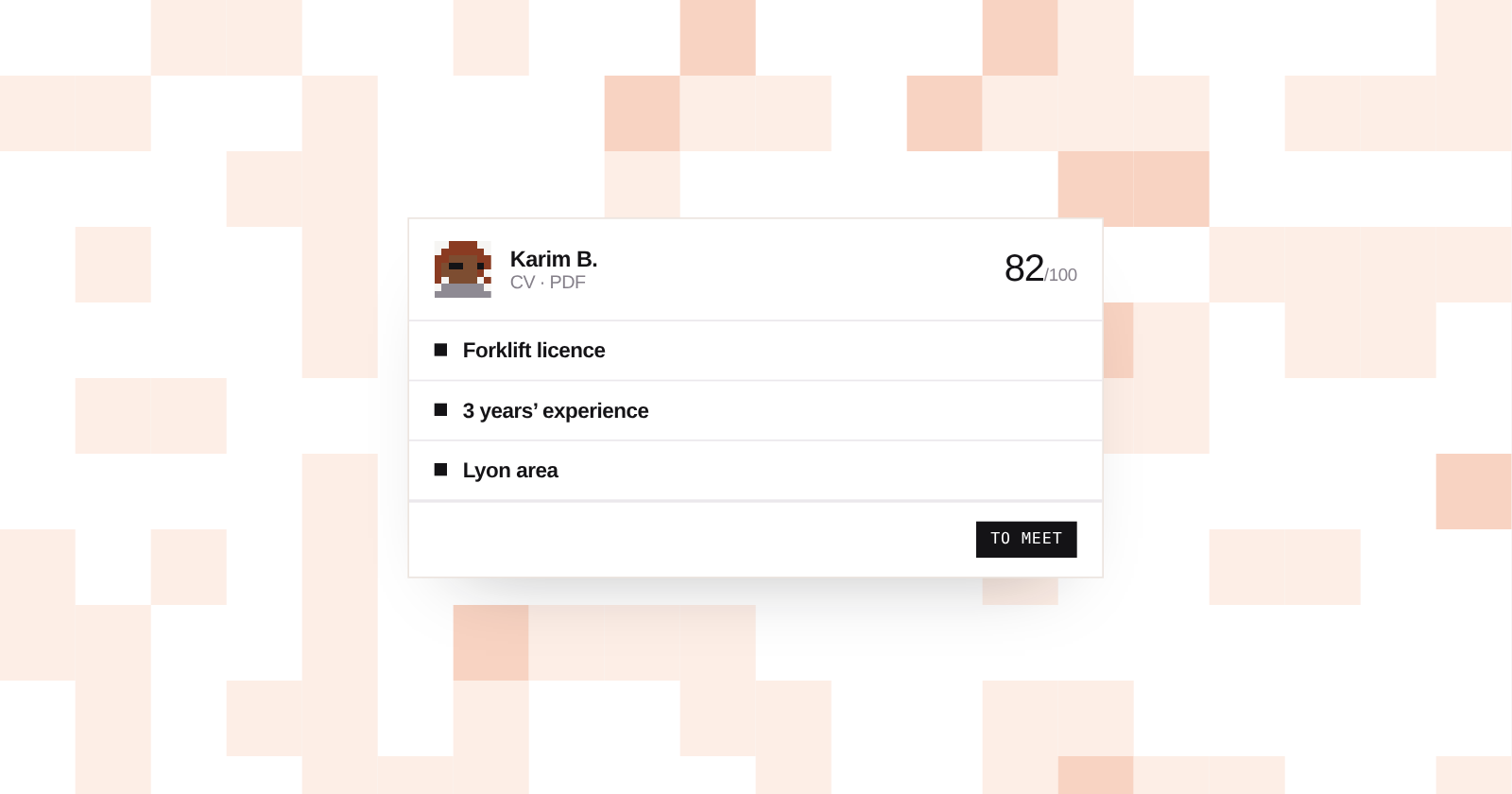
Take Karim B.’s CV. The CACES 3 is there: met, 5 points. He lists two years of forklift driving rather than three: partially met, 2.5 points. He lives in Vénissieux, just outside Lyon: met, 5 points. Total: 12.5 points out of 15. Had his CV not mentioned the CACES 3, the file would have moved to Review whatever his score: a recruiter would then have asked him the question rather than turning him down.
Why does a screening score need to be explainable?
Because a score without an explanation is useless the day it gets something wrong. If a strong candidate is screened out, you need to be able to trace why: which criterion, which piece of information in the CV, what reasoning. With a justification for each criterion, the mistake shows up in a few seconds, and you can correct the grid rather than doubting the whole tool.
It is also a matter of accountability. The European Union’s AI regulation, the AI Act, classes systems that analyse and filter job applications as high-risk uses, with requirements for traceability and human oversight. A screening process in which every verdict keeps the criterion, the information found and the justification can be reviewed and defended. The screening report for each CV can also be downloaded from the Studio.
Finally, it is a matter of trust within the team. Recruiters will hand over a first read if they can check the work. A magic score is something they end up working around.
What are the limits of AI CV screening?
Automated screening is a first read, not a judgement on a person. It has limits that are worth knowing.
- A CV only says what the candidate wrote. A skill missing from the CV is not necessarily missing in the person. Hence the value of “Ignore if missing” for secondary criteria, and of the Review status for must-haves.
- Some documents are hard to read. A blurry photo or an unusual layout makes reading harder, even with OCR. When a file cannot be processed, it moves to Error: nothing is decided silently.
- The grid determines the quality of the screening. A badly worded criterion produces questionable verdicts, applied to everyone. Read through the first results of a hiring project before you trust it.
- A CV measures neither motivation nor real availability. Those are checked by talking to the candidate, for example through prequalification (see how an AI prequalification agent works).
- The tool applies your criteria; it does not judge them. If they are poorly chosen, they will be applied consistently all the same. Responsibility for the grid stays with you.
What should you do with unsuccessful candidates and old CVs?
A candidate who does not fit one job may fit the next. Your talent pool often holds the right profiles, provided you can find them again.
- Talent Rediscovery starts from a description in plain language and reranks the profiles already in your talent pool, with a score for each criterion so you know why a profile rises to the top.
- Campaigns get back in touch with those people on WhatsApp, by SMS or by email, to update their profile or offer them a job (see how to keep your talent pool alive).
If, on the other hand, you are short of applications, the Sourcing agent, currently in beta, starts from the job description and hands you a ranked list of profiles, with the reason for each rank. And when candidates have no up-to-date CV, WhatsApp applications generate one from the conversation.
How do you set up automated screening without losing control?
A few steps are enough:
- Start from a real job and list its genuine requirements, not its ideal job description.
- Mark as must-haves only the conditions that are truly non-negotiable.
- Decide, criterion by criterion, whether missing information should count against the candidate or be ignored.
- Read through the first files marked Approved and Review, then adjust the grid or the threshold.
- Keep the decision: the status is a recommendation, and selection remains a human call.
If your team works in an ATS, the agent can plug straight into it. The price of each analysis is set out on the Pricing page.
To try the screening on one of your own jobs, the free trial gives you 500 credits for 7 days, no credit card required.